Wizpresso Adnoto fits a fast-growing need: organizations are under pressure to process more applications, faster, while staying fully compliant and audit-ready. Below is an SEO-optimized article you can adapt for your website or campaigns.
What Is Application Vetting and Why It Matters Now
Across funding, licensing, credit, hiring, research, awards, and legal approvals, application vetting is the process of collecting, reviewing, and validating submissions before a decision is made. As volumes grow and regulations tighten, manual vetting struggles to keep up—creating bottlenecks, inconsistent decisions, and compliance risk.
Digital transformation has pushed more of these processes online, from grant portals to e-licensing systems, while regulators demand stronger evidence of due diligence and auditability. This has made automated, AI-powered application vetting platforms an essential part of modern compliance and operations strategies.
Market Trends: Why AI-Powered Vetting Is Surging
Several data points show why investment in application vetting and AI-driven due diligence is accelerating:
- In compliance functions, roughly 36 percent of organizations already use AI in areas such as monitoring, due diligence, and investigations, with adoption especially strong among larger and publicly listed firms.
- Industry research shows that firms deploying AI in due diligence have achieved cost reductions of up to 30 percent while improving decision-making speed and accuracy.
- In grantmaking, AI-assisted application screening is being used to automatically pre-screen applications against eligibility criteria, saving staff time, improving consistency, and promoting more equitable funding decisions.
These trends reflect a broader shift: organizations are moving from fragmented, manual workflows to integrated platforms that combine workflow automation, AI screening, and compliance-by-design.
The Compliance Challenge: Pain Points in Application Reporting
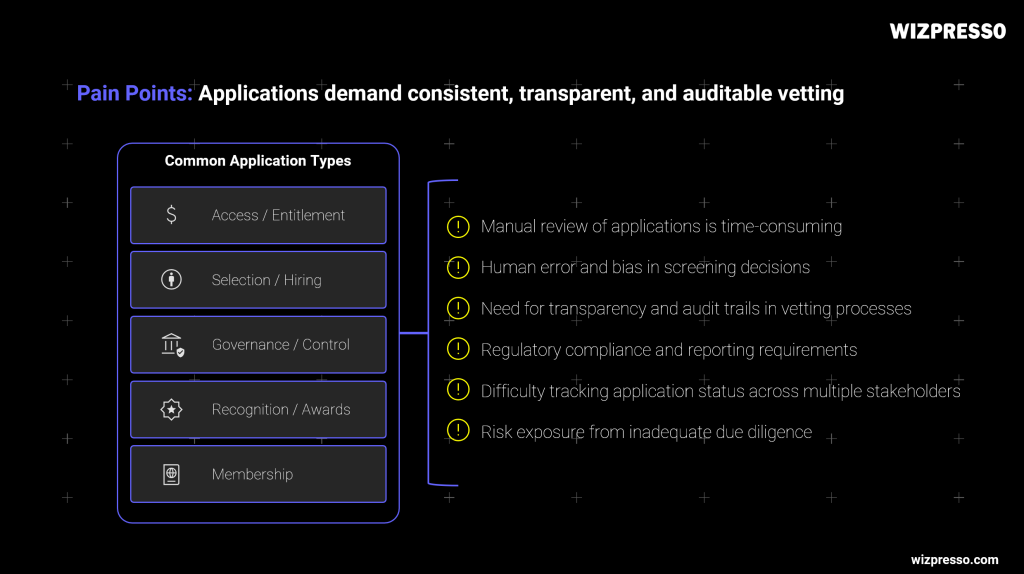
For teams managing funding, grants, licenses, credit approvals, job applications, research ethics, awards, and legal filings, common pain points recur across sectors:
- Fragmented data and documentation: Application data often lives in spreadsheets, email threads, and disconnected portals, making it difficult to demonstrate a complete audit trail.
- Manual, error-prone reviews: Eligibility checks, document verification, and policy-based screening are still frequently handled manually, increasing the risk of inconsistent decisions and missed red flags.
- Limited transparency and governance: Without standardized workflows and stage tracking, it is hard for compliance and risk teams to answer basic questions like who approved what, based on which criteria, and when.
- Reporting overhead: Regulatory or funding bodies often require detailed reports on pipeline, outcomes, diversity, conflicts of interest, and exceptions, which can be labor-intensive to compile from disparate systems.
- Scalability pressures: Spikes in applications—for example during grant cycles or license renewals—can quickly overwhelm teams if processes are not automated.
Regulators are also increasing expectations around vendor due diligence, AI oversight, and documentation, which pushes organizations to adopt systems that make compliance demonstrable rather than just aspirational.
Application Vetting Across Key Use Cases
Although each domain has its own nuances, the core challenges of application due diligence are surprisingly similar.
1. Funding and Grants
Grantmakers and funding agencies must ensure that proposals meet eligibility criteria, align with program objectives, and comply with legal and ethical guidelines. AI-assisted screening is already helping organizations automatically compare application content with program requirements and flag ineligible or incomplete submissions.
When application vetting is automated and standardized, grant programs can reduce manual pre-screening time, increase consistency in scoring, and generate transparent reports for boards and oversight bodies.
2. Licensing and Regulatory Approvals
Government departments and regulators need to process licenses and permits while managing risk around fraud, safety, and regulatory breaches. Automated vetting allows them to cross-check submissions against rules, reference databases, and prior applications, making the process both faster and more defensible.
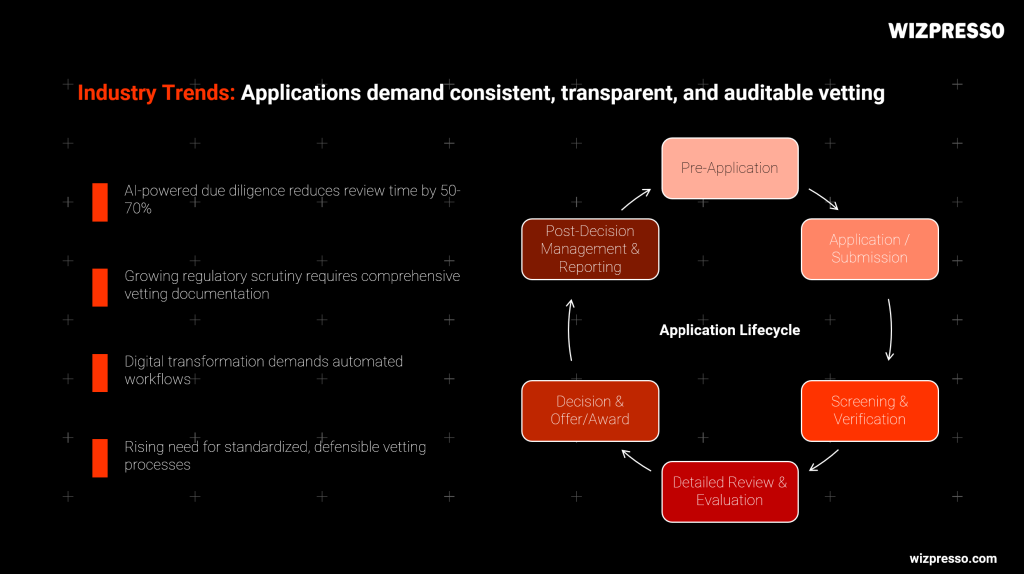
A structured workflow with clear stages—intake, eligibility, risk review, decision, and monitoring—also simplifies compliance with internal policies and external audits.
3. Credit and Financial Applications
Banks and financial institutions must balance customer experience with stringent KYC, AML, and credit risk management requirements. AI-powered due diligence can process large volumes of documentation, detect anomalies, and help identify high-risk entities more efficiently than manual reviews.
Automated vetting, combined with audit-ready reporting, reduces the risk of non-compliance with regulatory standards while supporting faster turnaround times.
4. Job and Recruitment Applications
Large employers and public institutions increasingly face high application volumes and expectations around fairness and transparency. While hiring decisions remain human-led, automated vetting can help standardize how basic eligibility criteria and documentation are validated, reducing the administrative burden on HR and compliance teams.
Centralized case management and role-based permissions also reduce the risk of unauthorized data access and demonstrate compliance with privacy regulations.
5. Research, Awards, and Ethics Committees
Universities, foundations, and professional bodies manage applications for research projects, ethics approvals, fellowships, and awards. These processes often require panel-based review, conflict-of-interest checks, and documentation of how decisions were made.
Automated application vetting and workflow tools can support structured scoring, flagging potential conflicts, and generating comprehensive reports for institutional review boards or funders.
6. Legal Applications and Filings
Law firms and legal departments handle filings that must comply with procedural rules, data protection laws, and regulatory deadlines. AI can assist with document checks and compliance assessments, while structured workflows help ensure that every step is logged and traceable.
How an AI-Powered Platform Addresses Compliance Pain Points
An AI-first application vetting platform like Wizpresso Adnoto is designed to directly address these issues across use cases.
Smart E-Form Creation and Data Quality
AI-powered e-form creation and editing can help organizations digitize complex application forms with built-in validation rules, conditional fields, and guidance. This reduces incomplete or incorrect submissions at the source, improving data quality and reducing back-and-forth with applicants.
By structuring data from the start, organizations can also more easily generate the metrics required for regulatory reports, diversity tracking, and program evaluation.
End-to-End Case Management and Workflows
Centralized case management ensures that every application, whether for a grant, license, credit facility, job, research project, award, or legal process, follows a standardized workflow. Configurable edit, submission, and review workflows make it easier to implement organization-specific policies while keeping processes consistent.
Stage and classification management allows teams to see where each application sits in the pipeline, categorize by risk or type, and identify bottlenecks. This visibility is vital when compliance teams must demonstrate control over processing timelines and escalations.
Role-Based Permissions, Consent, and Approval Chains
Compliance and privacy requirements increasingly demand strict control over who can view, edit, and approve different parts of an application. Role-based permissions, consent tracking, and configurable approval workflows help organizations implement least-privilege access and clear segregation of duties.
This structure makes it easier to answer audit questions such as who accessed sensitive data, who approved a decision, and whether appropriate checks were performed.
AI-Powered Vetting and Cross-Checking
AI models can analyze documents, structured data, and even images to check consistency, detect missing information, and flag potential red flags. In some studies, AI has achieved accuracy rates close to 87–90 percent when reviewing legal agreements for regulatory compliance, demonstrating its ability to handle complex textual analysis at scale.
By cross-checking information against internal records or external data sources, AI can support fraud detection, policy enforcement, and regulatory adherence. This allows human reviewers to focus on higher-risk or nuanced cases while AI handles routine checks.
Reporting, Dashboards, and Audit Trails
Modern compliance requires not just doing the right thing, but proving it. Customizable dashboards and exportable reports give stakeholders real-time visibility into application volumes, approval rates, processing times, and exception trends.
Automated audit trails and reporting capabilities simplify regulatory submissions, board reporting, and internal audits by providing a single source of truth for decisions and processes.
Notifications, Collaboration, and Timeliness
Automated notifications and reminders help ensure that reviewers, approvers, and applicants stay on top of deadlines and tasks. Collaboration tools integrated into the vetting platform reduce the reliance on email, making it easier to keep discussions and decisions tied to specific cases.
This not only improves turnaround times but also supports compliance with time-bound obligations in regulations, grant agreements, and service-level commitments.
Why Organizations Are Moving to Platforms Like Wizpresso Adnoto
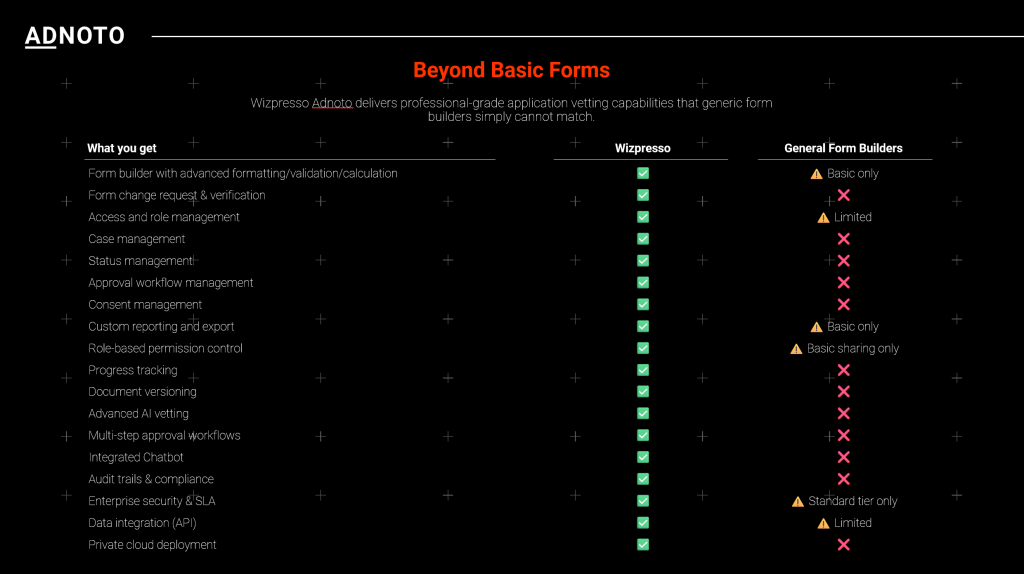
As application volumes rise and regulatory expectations grow, the business case for AI-powered application vetting continues to strengthen. Organizations that adopt integrated platforms can:
- Reduce manual workload and processing times by automating pre-screening and document checks.
- Improve compliance and audit readiness with structured workflows, access controls, and comprehensive logs.
- Enhance decision quality and consistency by standardizing criteria and leveraging AI for risk detection.
- Generate richer, faster reporting for regulators, funders, boards, and the public.
In sectors where trust, transparency, and regulatory alignment are non-negotiable, application vetting is no longer just an operational concern—it is a core pillar of governance and risk management.
Learn more about Adnoto here: https://wizpresso.com/products/Adnoto