Wizpresso has partnered with The Hong Kong Chartered Governance Institute (HKCGI) to release a new research white paper assessing how ready Hong Kong–listed companies are to adopt and govern artificial intelligence (AI) at scale.
Announcing our joint white paper with HKCGI
Wizpresso and HKCGI have jointly published “Bridging Innovation and Oversight: Five Governance Priorities – The State of AI Adoption and Governance amongst Hong Kong‑listed companies.” Based on empirical analysis of more than 2,500 latest annual and ESG reports from HKEX‑listed issuers, the study offers one of the most comprehensive market‑wide benchmarks to date on AI adoption and governance readiness in Hong Kong’s listed sector. The paper is designed as a practical resource for boards, company secretaries, and governance professionals who are navigating how to scale AI responsibly within existing corporate governance and regulatory frameworks.
Highlights
Brief summary of key findings
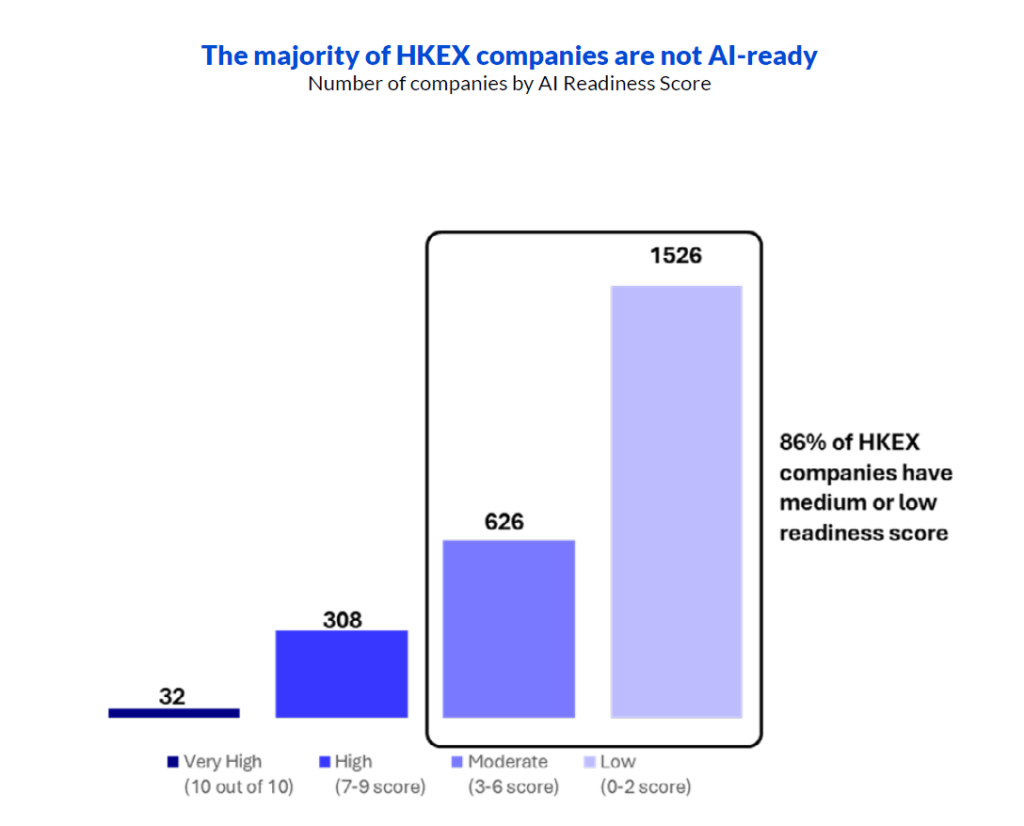
The research shows that AI has rapidly entered mainstream corporate discourse in Hong Kong, but governance and risk management practices have not kept pace with adoption. AI readiness is highly uneven across issuers, with a small group of leaders and a long tail of companies still at a foundational stage.
- Almost nine in ten HKEX‑listed issuers now reference AI in their latest annual or ESG reports, underscoring how quickly AI has become part of corporate strategy and narrative.
- Fewer than 20 percent of over 2,500 issuers disclose a structured AI governance framework with defined oversight roles, policies, and lifecycle controls, revealing a clear gap between AI ambition and genuine AI readiness.
- Across a ten‑dimension AI readiness framework, data privacy, security, and digital foundations are relatively more developed, while AI governance and ethics, risk and incident management, and AI investment, KPIs, and measurement rank as the weakest areas.
The analysis also highlights meaningful differences by size and sector.
- This is contributing to a widening readiness gap between a small cohort of AI leaders and a long tail of issuers that are adopting AI in name but without commensurate governance and control.
- Large‑cap and digitally intensive sectors such as financials, telecommunications, and information technology exhibit materially higher AI readiness scores, with clearer AI visions, stronger data foundations, and more explicit board oversight.
- Smaller issuers and traditional sectors are more likely to reference AI only in generic terms, with limited disclosure of concrete use cases, formal governance structures, or AI‑specific risk controls.
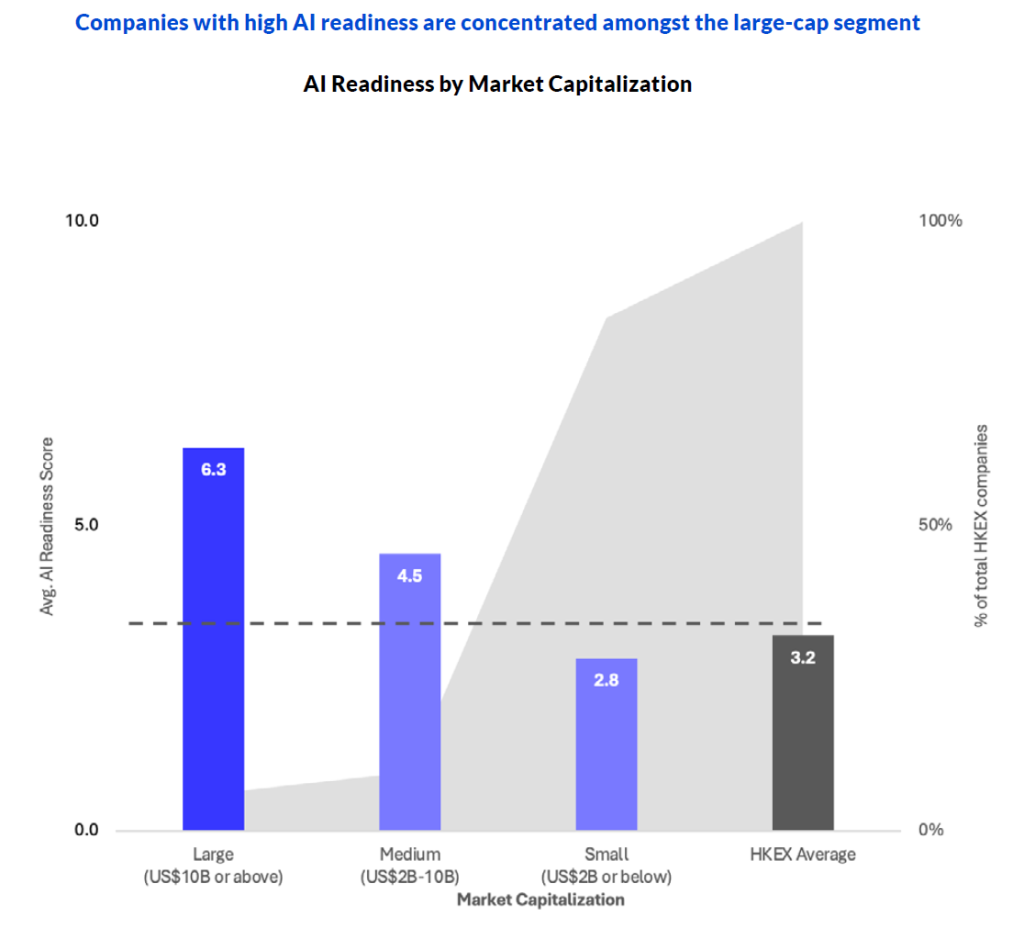
The analysis further indicates that AI readiness is uneven across the market, with large‑cap and digitally intensive sectors such as financials, telecommunications, and information technology exhibiting materially higher scores than smaller issuers and more traditional sectors. Many smaller and traditional‑sector companies reference AI only in generic terms, with limited disclosure of concrete use cases, formal governance structures, or AI‑specific risk controls. To help close this readiness gap, the white paper distils the findings into five governance priorities for HKEX‑listed companies: establishing clear visibility over AI use, assigning unambiguous senior accountability, integrating AI risks into existing risk frameworks, preserving meaningful human oversight, and ensuring that external AI disclosures are balanced and supported by real governance structures.
Why AI readiness matters now
As AI becomes embedded in strategy, operations, and reporting, AI is no longer just a technology topic but a core governance concern for HKEX‑listed issuers. Weak AI governance can translate into legal, regulatory, and fiduciary risks where AI systems materially influence financial reporting, customer outcomes, compliance processes, or public disclosures. At the same time, delaying engagement with AI or confining it to ungoverned pilots risks leaving companies behind on competitiveness, efficiency, and their ability to demonstrate robust oversight to regulators and investors.
The paper proposes a staged roadmap from foundational readiness to governed scaling, structured around the AI lifecycle of selection, hosting, and application. It also aligns AI governance practices with emerging benchmarks such as Hong Kong’s Generative AI Technical and Application Guideline and international standards like ISO/IEC 42001, enabling issuers to situate their own progress within a rapidly evolving regulatory and policy environment.
Methodology
Using Wizpresso’s capital markets disclosure database and agentic AI capabilities, the study systematically extracted and scored AI‑related disclosures that have been approved by boards and vetted by auditors, followed by human review to validate results. This scalable, disclosure‑based methodology provides regulators, investors, and issuers with a robust and repeatable way to track how AI readiness evolves over time in Hong Kong’s listed market. As a Hong Kong–based RegTech and AI company focused on governance, risk, and compliance, Wizpresso is committed to helping organisations operationalise responsible AI principles, reinforce board and management oversight, and deliver transparent, auditable disclosures to stakeholders.
Acknowledgements
Wizpresso extends its sincere thanks to The Hong Kong Chartered Governance Institute (HKCGI) for its leadership and partnership in advancing AI governance in Hong Kong. This white paper builds on HKCGI’s earlier “Responsible AI Policy Development – A Governance Playbook” and reflects our shared belief that strong governance is essential to turning AI from a buzzword into a source of sustainable value, resilience, and trust for Hong Kong‑listed companies. We look forward to continued collaboration with HKCGI, regulators, and market participants to support the next phase of AI adoption and governance across the Hong Kong market.