CFOs are now responsible for far more than financial reporting. They must demonstrate control over regulatory compliance, ESG disclosures, and operational risk—across multiple jurisdictions, fast-changing standards, and demanding stakeholders.
Spreadsheets, email threads, and scattered evidence repositories can no longer keep up. They increase error risk, slow audits, and leave CFOs exposed when regulators, investors, or rating agencies ask tough questions.
Wizpresso Diligence is built to solve this problem. It’s an AI-powered governance, risk, and compliance (GRC) platform that centralizes regulatory requirements, automates gap analysis, and streamlines reporting and audit workflows for finance, ESG, and risk teams.
What is Wizpresso Diligence?
Diligence is an AI-driven supervisory and GRC platform that tracks regulations, ESG standards, and operational frameworks across jurisdictions, converting them into actionable checklists and audit-ready reports.
It unifies disclosures, policies, procedures, and evidence in one control center, allowing CFOs and their teams to see, in real time, how well the organization complies with internal policies and external requirements.
Key capabilities include:
- Regulatory & ESG framework tracking – Monitor changes in listing rules, prudential regulation, cyber and operational standards, and ESG frameworks (e.g., TCFD, SASB, GRI, IFRS Sustainability standards) in one place.
- Actionable compliance checklists – Automatically convert circulars, standards, and guidelines into structured checklists mapped to your internal controls and documents.
- Automated gap analysis – Compare disclosures, policies, and evidence to requirements; score gaps; flag inconsistencies; and generate remediation steps to close them.
- Centralized documentation management – Maintain a single source of truth for policies, procedures, evidence, and board/audit materials with version control and immutable audit trails.
- Compliance monitoring and alerts – Track compliance status across frameworks, deadlines, and risk items with smart alerts for reviews, approvals, and submissions.
- Drafting and benchmarking – Use generative AI to draft regulatory and ESG disclosures, benchmark performance against peers, and validate alignment with market and regulatory expectations.
- Audit automation – Automate evidence collection, verification, and responses to audit inquiries with AI-generated explanations grounded in your underlying documents.
Why Diligence Matters to CFOs
1. Financial-Grade ESG and Regulatory Reporting
For listed companies, ESG and climate disclosures are now held to the same standard as financial statements. Regulators and investors expect accurate, verifiable, and comparable data across multiple frameworks and jurisdictions.
Diligence helps CFOs:
- Map disclosures to ESG and regulatory standards automatically.
- Validate every disclosed item against source evidence and relevant requirements.
- Benchmark performance against peers and market leaders.
This gives finance leaders confidence that ESG sections of annual reports, standalone sustainability reports, and regulatory filings are audit-ready and defensible.
2. Turning Fragmented Controls into a Single Compliance Hub
Most organizations manage controls, policies, and evidence across multiple systems—policy portals, file shares, ticketing tools, and GRC spreadsheets.
Diligence consolidates these into a single operational compliance hub, so CFOs can:
- See end-to-end coverage of key risks across subsidiaries and business units.
- Track policies from creation to approval to periodic review.
- Link controls and evidence directly to regulatory and ESG requirements.
This eliminates blind spots and enables faster, more coherent responses to board, auditor, and regulator queries.
3. Faster, Cheaper Audits
Audit cycles tie up finance and risk teams for months, leaving less bandwidth for strategic work.
With Diligence, CFOs can:
- Maintain a living audit file that is continuously updated as controls operate and evidence is collected.
- Provide auditors with secure, permissioned access to relevant documents and AI-generated responses.
- Reduce manual sampling and rework through automated integrity checks and anomaly detection.
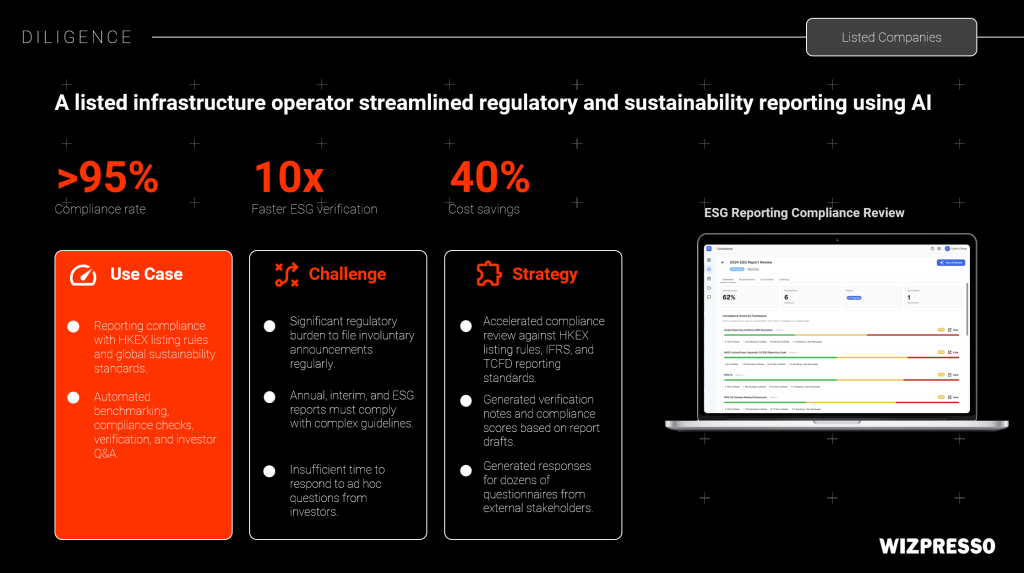
In one large financial institution, Diligence enabled tracking of over 100 frameworks across 30+ jurisdictions, achieving a 95% compliance rate, 15x faster audit response, and around 60% cost savings.
4. Staying Ahead of Regulatory Change
Regulators are rapidly updating climate, cyber, and operational resilience expectations, especially across APAC and global markets.
Diligence continuously monitors regulatory updates, flags impact to your organization, and guides teams on what needs to change in policies or disclosures.
This turns regulatory change from an ad-hoc fire drill into a repeatable, proactive process—critical for CFOs accountable for compliance budgets and risk appetite.
5. Demonstrating Control to Boards, Investors, and Regulators
Boards and audit committees increasingly ask the CFO: “Can you show us how we are complying, what our gaps are, and what’s being done about them?”
Diligence provides dashboards, heatmaps, and drill-down reports that show:
- Compliance status by framework, geography, and business unit.
- Open issues, remediation actions, and owners.
- Trends in control effectiveness and audit findings.
CFOs can demonstrate not just compliance, but governance over compliance, strengthening trust and reducing reputational risk.
How Diligence Works in Practice
- Ingest & Map – Diligence ingests regulatory texts, circulars, ESG standards, listing rules, and your internal policies and disclosures. It then maps each requirement to the relevant documents and controls.
- Assess & Score – AI performs gap analysis, scoring compliance readiness, highlighting missing or inconsistent evidence, and suggesting remediation actions.
- Monitor & Alert – The platform tracks compliance status, upcoming deadlines, and regulatory changes, notifying owners when action is needed.
- Report & Audit – Diligence generates audit-ready reports and supports auditors with structured evidence, traceable controls, and AI-generated explanations grounded in the underlying data.
This workflow supports finance, ESG, risk, audit, legal, and security teams while giving the CFO a single, trusted view of compliance posture.
Example CFO Use Cases
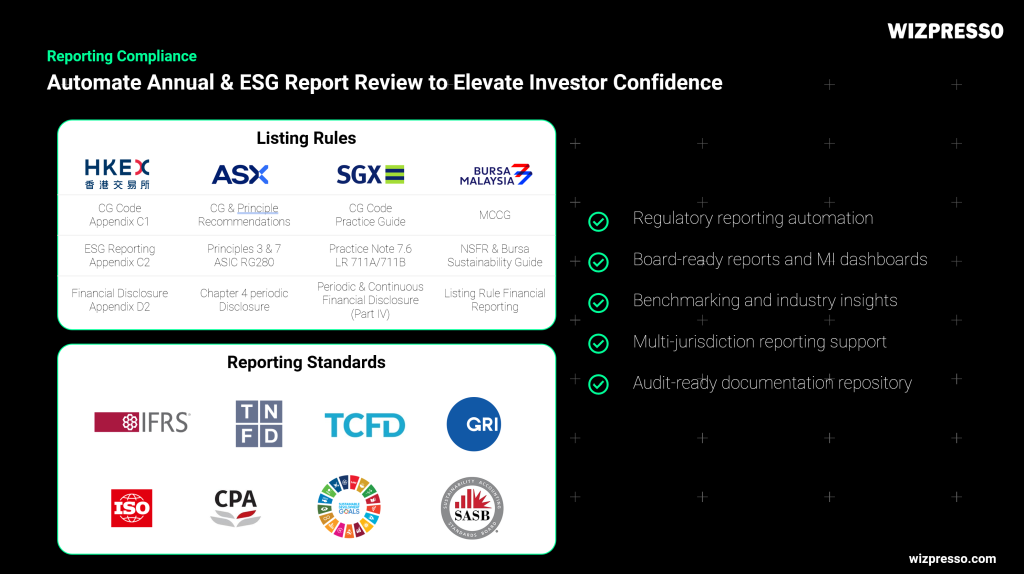
- ESG & climate reporting – Prepare and validate ESG and climate disclosures against frameworks such as TCFD, SASB, GRI, and IFRS Sustainability standards, with automated mapping and gap analysis.
- Post-listing compliance – Ensure ongoing adherence to post-listing disclosure rules, including climate-related and sustainability disclosure mandates effective from 2025 onwards.
- Operational & cyber resilience – Track compliance with ISO 27001, HKMA cyber resilience requirements, and internal IT/security policies across entities and jurisdictions.
- Internal & external audits – Maintain continuous audit readiness, reducing preparation time and facilitating efficient collaboration with internal audit and external auditors.
CFO-Focused FAQ on Wizpresso Diligence
1. How does Diligence help a CFO ensure ESG and regulatory compliance?
Diligence consolidates ESG and regulatory frameworks into a single platform, maps them to your disclosures and controls, and continuously checks for gaps and misalignments.
It ensures that what you publish in annual reports, standalone ESG reports, and regulatory filings is backed by evidence and aligned with current rules.
2. What regulatory and ESG frameworks does Diligence support?
Diligence tracks a wide range of frameworks, including listing rules, prudential regulations, information security standards (e.g., ISO 27001), and global ESG standards such as TCFD, SASB, GRI, and IFRS Sustainability standards.
It can be configured to incorporate jurisdiction-specific requirements, such as HKMA guidelines or local climate disclosure rules.
3. How does Diligence reduce manual work for finance and ESG teams?
The platform automates tasks such as regulatory monitoring, requirement-to-document mapping, gap analysis, and evidence collection.
Teams spend less time chasing documents and updating spreadsheets, and more time interpreting insights and planning remediation.
4. Can Diligence benchmark our ESG performance against peers?
Yes. Diligence leverages structured ESG data to benchmark your disclosures and performance metrics against peers and market leaders, highlighting where you lead or lag.
This is particularly valuable for CFOs preparing board materials, investor presentations, or responses to rating agencies.
5. How does the platform support audit readiness?
Diligence centralizes evidence, links it to requirements and controls, and maintains immutable audit trails.
Auditors can be given secure access to tailored views, allowing them to self-serve much of the information they need and leverage AI-generated responses to specific queries.
This significantly shortens audit cycles and reduces disruption to finance teams.
6. What are the measurable benefits for CFOs?
Organizations using Diligence have reported up to 95% compliance rates, 15x faster audit responses, and around 60% cost savings in audit and control activities.
For CFOs, this translates into lower compliance costs, fewer surprises, and stronger confidence when signing off on disclosures.
7. How does Diligence help manage multi-jurisdictional complexity?
Diligence aggregates requirements from multiple jurisdictions and frameworks into a unified view, mapping them to your global policies and local implementations.
CFOs can see where a single control satisfies multiple regulations and where local variations require additional work.
8. How is Diligence different from a traditional GRC system?
Traditional GRC tools rely heavily on manual configuration and static controls libraries.
Diligence uses machine learning and generative AI to interpret regulatory texts, automatically build checklists, and generate responses to audit and investor queries based on your own data.
This reduces implementation time and keeps the system relevant as regulations change.
9. How long does it take to get value from Diligence?
Because Diligence can ingest existing policies, disclosures, and evidence, organizations can begin seeing insights—such as gap analysis and compliance dashboards—within weeks, not years.
Subsequent phases can extend coverage to more frameworks, entities, and processes as needed.
10. How does Wizpresso ensure data security and confidentiality?
Wizpresso provides enterprise-grade infrastructure with robust access controls, encryption, and audit trails to protect sensitive corporate data.
Role-based permissions ensure that only authorized stakeholders can view or act on specific records, evidence, or reports.
11. Can Diligence be used by other functions beyond Finance?
Yes. While CFOs often sponsor the initiative, Diligence is built to support ESG, risk, internal audit, legal, information security, and investor relations teams.
This cross-functional design helps organizations manage compliance holistically rather than in silos.
12. How do we get started?
Wizpresso typically begins with a discovery and scoping phase focused on your priority frameworks—such as ESG reporting or a specific regulatory regime—followed by a pilot that demonstrates quick wins in gap analysis and audit readiness.
From there, Diligence can be scaled across business units and jurisdictions as your compliance strategy evolves.
Learn more about our GRC platform, Diligence, by visiting: https://wizpresso.com/products/Diligence