
On 21 September 2026, The Stock Exchange of Hong Kong Limited (the Exchange) published a consultation paper on the second phase of its listing framework competitiveness review. This phase turns to the rules that apply after listing, proposing changes to how listed issuers handle notifiable transactions, connected transactions and spin-offs.
The direction is clear: give issuers more flexibility and certainty in their corporate transactions, while relying more on timely, meaningful disclosure and board accountability to protect shareholders. The consultation closes on Monday, 30 November 2026.
What the Exchange is proposing
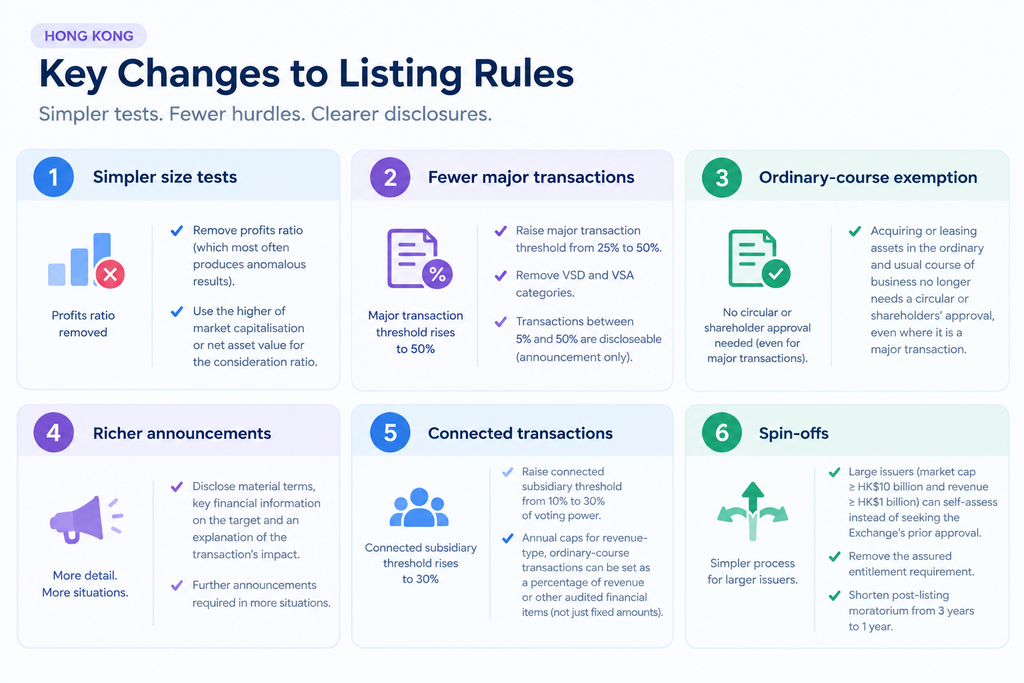
The proposals cover three areas of the post-listing rules:
- Simpler size tests: the profits ratio, which most often produces anomalous results, would be removed. Issuers could also measure the consideration ratio against the higher of their market capitalisation or net asset value.
- Fewer major transactions: the major transaction threshold would rise from 25% to 50%, and the very substantial disposal (VSD) and very substantial acquisition (VSA) categories would be removed. Transactions between 5% and 50% would be discloseable transactions, requiring an announcement only.
- Ordinary-course exemption: acquiring or leasing assets in the ordinary and usual course of business would no longer need a circular or shareholders’ approval, even where it is a major transaction.
- Richer announcements: every notifiable transaction announcement would need to disclose the material terms, key financial information on the target and an explanation of the transaction’s impact. Further announcements would be required in more situations.
- Connected transactions: the “connected subsidiary” threshold would rise from 10% to 30% of voting power. Annual caps for revenue-type, ordinary-course transactions could be set as a percentage of revenue or other audited financial items, not just as fixed amounts.
- Spin-offs: large issuers (market capitalisation of at least HK$10 billion and revenue of at least HK$1 billion) meeting further conditions could self-assess instead of seeking the Exchange’s prior approval. The assured entitlement requirement would be removed, and the post-listing moratorium would shorten from three years to one.
Flexibility shifts the burden to process
Fewer shareholder approvals and circulars do not mean less compliance work. Under the proposals, more transactions would be handled through announcements rather than circulars, and those announcements would carry more prescribed content. Eligible issuers taking the self-assessment route for spin-offs would be making judgements that currently sit with the Exchange. In each case, the quality of the issuer’s own processes, and the board’s oversight of them, matters more.
For company secretarial, legal and investor relations teams, that means revisiting the procedures behind every transaction: how size tests are calculated, which disclosure items an announcement must contain, how connected persons and subsidiaries are identified, and how decisions are documented for the board. Because these are still proposals, teams also need to track the consultation through to its conclusions and be ready to update quickly once final rules are published.
Preparing with Diligence
This is where tools like Diligence can help. Diligence is Wizpresso’s AI-powered governance, risk and compliance platform, designed to turn regulatory text into structured requirements and keep internal policies aligned as rules change.
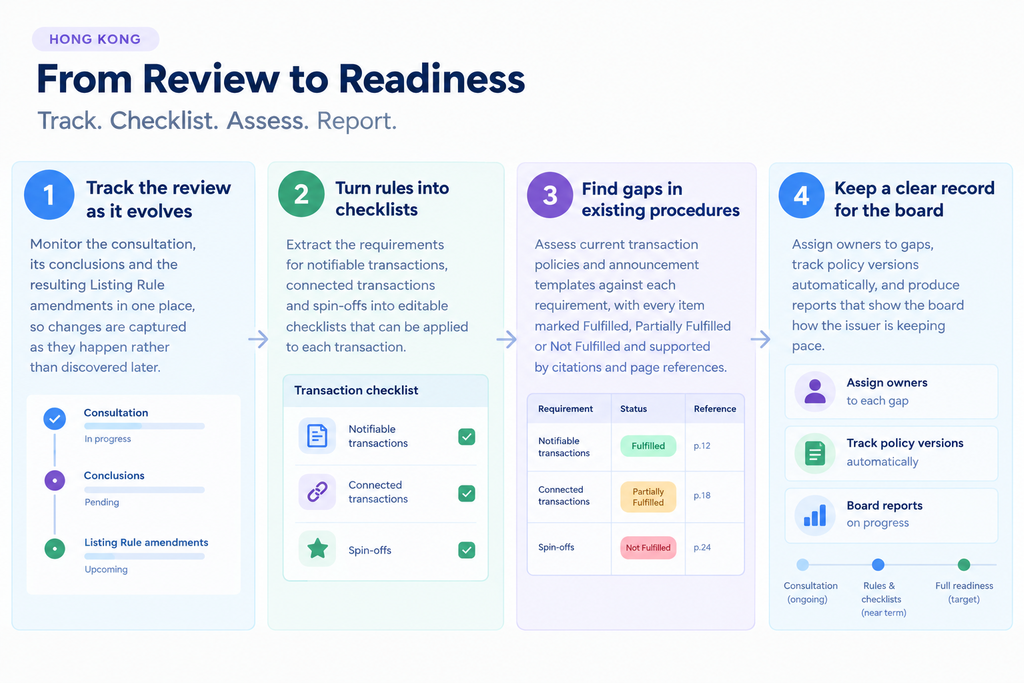
- Track the review as it evolves: monitor the consultation, its conclusions and the resulting Listing Rule amendments in one place, so changes are captured as they happen rather than discovered later.
- Turn rules into checklists: extract the requirements for notifiable transactions, connected transactions and spin-offs into editable checklists that can be applied to each transaction.
- Find gaps in existing procedures: assess current transaction policies and announcement templates against each requirement, with every item marked Fulfilled, Partially Fulfilled or Not Fulfilled and supported by citations and page references.
- Keep a clear record for the board: assign owners to gaps, track policy versions automatically, and produce reports that show the board how the issuer is keeping pace.
Every AI-generated assessment can be reviewed, edited and approved by the issuer’s own professionals, so judgement stays with the people accountable for it.
Ready for the rules that follow
The competitiveness review reflects a wider shift in Hong Kong’s listing regime towards flexibility backed by disclosure and accountability. Issuers that build structured, well-documented transaction processes now will be able to take advantage of the new flexibility with confidence, whatever form the final rules take.
👉 Learn more about Diligence and request a demo: https://wizpresso.com/products/Diligence
Read the Exchange’s announcement: https://www.hkex.com.hk/News/Regulatory-Announcements/2026/260921news?sc_lang=en